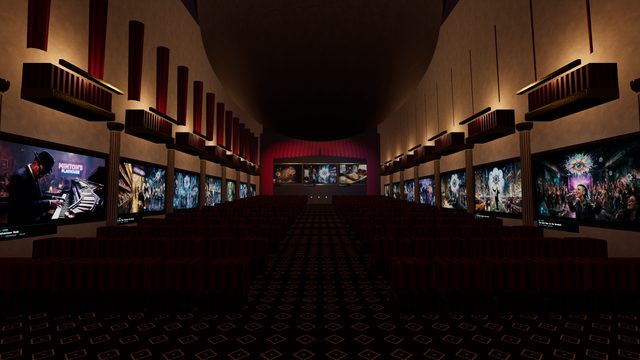
West 125th Street at night, the marquee running its bulbs and the red sign straight up the front, the Tree of Hope in the lobby for luck, then a velvet house of three levels with a singer out in the follow spot and the whole room moving with her. The works hang down both sides of the house and on the back wall of the stage.
The building at 253 West 125th Street opened in 1914 as Hurtig and Seamon's New (Burlesque) Theater, designed by George Keister, and it originally served only white patrons. Sidney Cohen bought it in January 1934 and reopened it on January 26, 1934 as the 125th Street Apollo Theatre, a stage for Black entertainers, with Morris Sussman hosting amateur competitions on Wednesday nights. It seats about 1,500 on three levels. The Tree of Hope, a stump performers rub for luck, stands in the lobby. The city made it a landmark on June 28, 1983.
Source · Apollo Theater, Wikipedia ↗
The vertical APOLLO sign and the marquee with its chasing bulbs on 125th Street, the Walk of Fame plaques on the sidewalk, the Tree of Hope stump in the lobby, the gilt proscenium with its red drapes, two balconies over the orchestra, the footlights, a singer in the follow spot, the band, and a full house. Mood: amateur night. Everything is procedural geometry with painted surfaces; nothing is a scan or a photograph. The room is an interpretation, and it hangs the New Yorkers the census recorded at this place first.