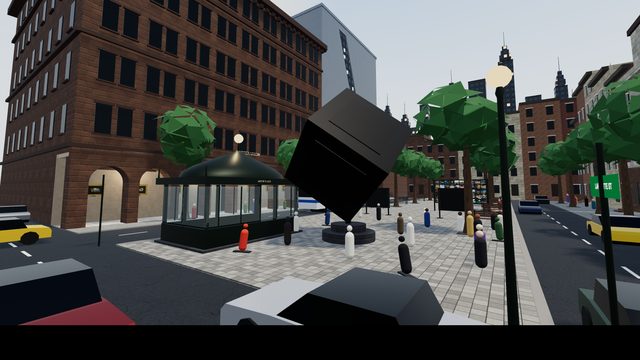
Astor Place, where the East Village meets NoHo: Tony Rosenthal's black steel cube balanced on one corner in the middle of the plaza, the cast iron subway kiosk beside it, Cooper Union's brownstone Foundation Building across Cooper Square and the slotted steel skin of 41 Cooper Square beyond, skaters going round, students crossing, buses on Fourth Avenue. Walk up to the cube and lean on it: it turns, and slowly comes to rest. The New Yorkers hang under the Foundation Building's arcade, on the plaza face of 41 Cooper Square, in the theatre's poster cases on Lafayette Street and on boards round the plaza.
Tony Rosenthal's Alamo, a Cor-Ten steel cube 15 feet on a side weighing about 1,800 pounds, was installed in 1967 as one of 25 temporary works in the city's Sculpture and the Environment show, meant to stay six months; residents petitioned to keep it, and it rotates round a hidden pole in its centre. The name was chosen by the artist's wife because its mass reminded her of the Alamo Mission. It was removed for work in March 2005 and returned in November 2005, removed in October 2015 and returned on November 1, 2016, and removed in May 2023 and returned in August 2023. Astor Place station opened on October 27, 1904 as one of the original 28 IRT stations; its plaques carry beavers because John Jacob Astor's fortune came from the beaver pelt trade; the cast iron kiosk is a replica 13 feet wide, 22 feet long and 16 feet tall, made at the same factory as the originals and installed in the renovation completed in May 1986 at the urging of the architect Rolf Ohlhausen, who had photographed the originals as a Cooper Union student. Cooper Union's Foundation Building, by Fred A. Petersen, 1858 to 1859, Italianate brownstone, was the first building in New York with rolled iron I beams and the first in the world built with an elevator shaft; Abraham Lincoln spoke in its Great Hall on February 27, 1860 to about 1,500 people, and it became a National Historic Landmark on July 4, 1961. 41 Cooper Square, by Thom Mayne of Morphosis, built 2006 to September 2009, nine storeys and 175,000 square feet behind a perforated stainless steel curtain wall round a vertical piazza, was the first institutional building in New York to reach LEED Platinum. Astor Place was named for John Jacob Astor soon after his death in 1848; the Astor Place Riot of May 10, 1849 killed at least 18 people; the reconstruction begun in 2013 and finished in 2016 widened the plazas and made Fourth Avenue south of East 9th Street bus only.
The Alamo (1967), fifteen feet of Cor-Ten steel on one corner, the 1986 replica IRT kiosk in cast iron and glass, the Foundation Building (1859) with its round arched arcade and five brownstone storeys, 41 Cooper Square (2009) with the slot cut up through its perforated skin, the black glass of 51 Astor Place, the colonnade and the theatre on Lafayette Street, the skaters, the students and the buses. Mood: push it and it turns. Everything is procedural geometry with painted surfaces; nothing is a scan or a photograph. The room is an interpretation, and it hangs the New Yorkers the census recorded at this place first.