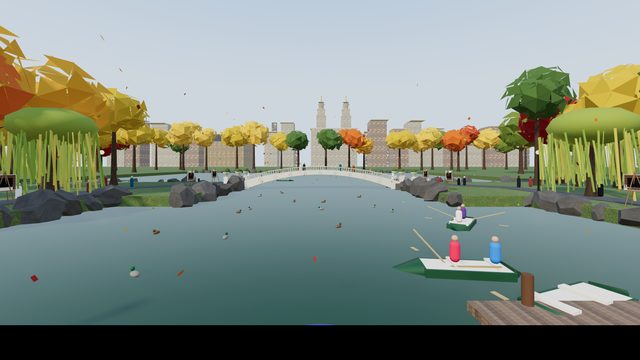
Bow Bridge on an October afternoon, seen from the east arm of the Lake the way everyone photographs it: the cast iron span in cream, its eight urns, the willows on the banks and the Ramble going gold behind, rowboats from the Loeb Boathouse sliding under the arch, and the twin towers of the San Remo standing over the trees on Central Park West. The New Yorkers hang on painters' easels along the banks and under the boathouse canopy, facing the paths.
Bow Bridge was designed by Calvert Vaux and Jacob Wrey Mould and completed in 1862; the ironwork was made by Janes, Kirtland and Company, the Bronx foundry that also built the dome of the United States Capitol. It is cast iron, 87 feet long with a single 60 foot span, with an interlocking circle banister and eight planting urns, and it is the only one of the park's seven ornamental iron bridges that does not cross a bridle path. It was restored in 1974. The Lake covers 20 acres and was the first feature of the park completed, opening as a skating ground in December 1857. The Loeb Boathouse on its eastern shore was completed in 1954 with money from Carl M. Loeb and rents rowboats. Over the trees stands the San Remo, by Emery Roth, completed in 1930 at 27 stories and 400 feet, its twin towers topped by temples patterned after the Choragic Monument of Lysicrates.
Source · Bow Bridge (Central Park), Wikipedia ↗
Calvert Vaux and Jacob Wrey Mould's 1862 cast iron bridge with its shallow arch, interlocking circle railing and eight planting urns, the Lake and its schist shore, rowboats with rowers, mallards, weeping willows and autumn trees, the Ramble to the north and Cherry Hill to the south, the Loeb Boathouse and its dock, and the San Remo, the Dakota and the Central Park West skyline over the trees. Mood: october, oars in the water. Everything is procedural geometry with painted surfaces; nothing is a scan or a photograph. The room is an interpretation, and it hangs the New Yorkers the census recorded at this place first.