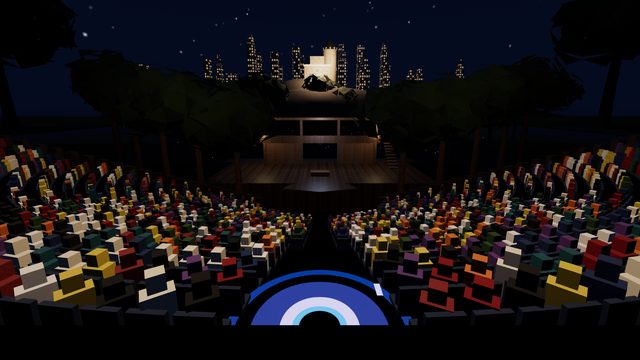
The Delacorte Theater on a summer night, the free Shakespeare in the Park of the Public Theater. You stand at the top of the bowl with the house full below you, five players moving between their marks on the open stage, the lights sweeping and changing colour, Turtle Pond black behind the stage with fireflies over it and Belvedere Castle lit on Vista Rock above, a moon over the trees. Before eight the house lights are up and the stage waits; from eight the house goes dark and the play is on. The New Yorkers hang on the theatre's outer wall, in the lobby and on the boards along the ticket line, never on the stage.
Joseph Papp conceived Shakespeare in the Park in 1954; in 1959 the parks commissioner Robert Moses demanded that he charge for the performances to pay for grass erosion, Papp won in court, and a theatre was then built for him in the park. The Delacorte opened in June 1962 with The Merchant of Venice; George T. Delacorte Jr., president of Dell Publishing, gave the last 150,000 dollars to finish it and it was named for him and his wife Valerie. Every ticket is free and is distributed on the day of the performance, two to a person, by the box office, borough distribution and lotteries; about 80,000 people attend each summer and over five million have attended more than 150 free productions since 1962. The theatre closed for renovation in September 2023, an 85 million dollar rebuild, and reopened on July 15, 2025. Behind the stage lie Turtle Pond, on the site of the old receiving reservoir, and Belvedere Castle, designed by Calvert Vaux and Jacob Wrey Mould in 1867 and finished in 1869 on Vista Rock, a 130 foot schist outcrop, home to Central Park's official weather station since 1919.
The semicircular bowl of seats full to the top, the thrust stage with its wooden set and stair, the lighting towers and their beams, Turtle Pond behind the stage, Belvedere Castle on Vista Rock with its tower and conical cap floodlit, the moon, the fireflies over the water, the laugh that goes through the house, the queue rail and the boards along it, and the wooden slat wall of the rebuilt theatre. Mood: curtain at eight, the castle lit behind the stage. Everything is procedural geometry with painted surfaces; nothing is a scan or a photograph. The room is an interpretation, and it hangs the New Yorkers the census recorded at this place first.