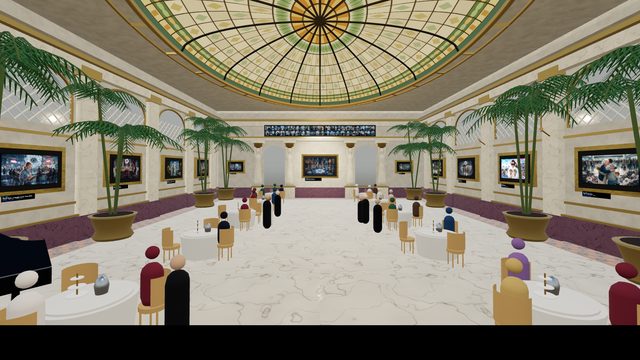
The Palm Court in the middle of the Plaza, where afternoon tea has been poured under a ceiling of stained glass since 1907. The palms stand in their planters along the trellis, the waiters work the aisle between the white cloths, the piano plays, and through the Fifth Avenue doors the Pulitzer Fountain splashes in Grand Army Plaza. The New Yorkers hang in the gilded bays between the pilasters, under the mirrors, where the room has always hung its finery.
The Plaza opened on October 1, 1907, with 800 rooms, designed by Henry Janeway Hardenbergh; its main entrance faces the Pulitzer Fountain in the southern part of Grand Army Plaza. The Palm Court's stained glass ceiling was removed in a renovation in the 1940s and restored in the mid 2000s, and four caryatids representing the seasons frame its wall mirrors, over walls of Caen stone and Breche Violette marble and mosaic floors. The exterior became a city landmark on December 9, 1969, and the interior on July 12, 2005.
Source · The Plaza Hotel, Wikipedia ↗
The stained glass laylight with its amber medallion and green garlands, tall palms in planters, cream trellis panels and arched mirrors, the four caryatids on the west wall, Caen stone pilasters over purple Breche Violette marble, the mosaic floor, tea tables with white cloths and cane chairs, waiters in black, a grand piano, and the Pulitzer Fountain and Fifth Avenue through the doors. Mood: tea under the glass. Everything is procedural geometry with painted surfaces; nothing is a scan or a photograph. The room is an interpretation, and it hangs the New Yorkers the census recorded at this place first.