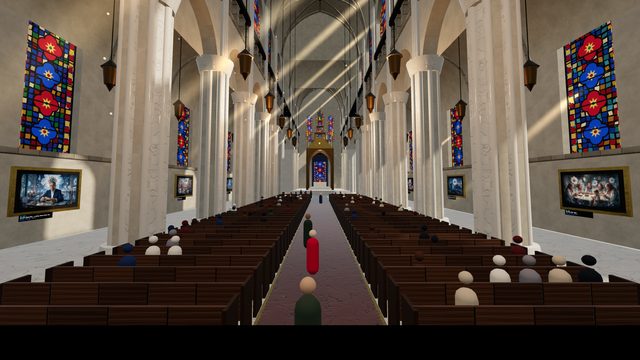
The Gothic Revival nave on Fifth Avenue at eleven in the morning: thirty two white columns, rib vaults a hundred feet up, sun coming through the south clerestory in coloured shafts, the bronze baldachin over the high altar, the rose window and the great organ over the open doors, and a few hundred candles going in the transepts. The New Yorkers hang along the side aisles where the Stations of the Cross would be, under the windows, and at the ends of the transepts.
St. Patrick's Cathedral was designed by James Renwick Jr. in the Gothic Revival style. The cornerstone was laid on August 15, 1858, work stopped during the Civil War, and the cathedral was dedicated on May 25, 1879; the spires, 329.5 feet tall, were finished in 1888. It is 332 feet long and 174 feet wide at the transepts. Thirty two white marble columns, five feet across, divide the aisles and rise 35 feet to the arches. The rose window over the Fifth Avenue doors is 26 feet across and was designed by Charles Connick; below it is the Gallery Organ, dedicated in 1930, one of two organs by George Kilgen & Son with more than 9,000 pipes between them. The grey white marble high altar under a bronze baldachin was designed by Charles Maginnis after 1941. It became a National Historic Landmark on December 8, 1976.
Source · St. Patrick's Cathedral (Manhattan), Wikipedia ↗
The nave by James Renwick Jr. with its clustered marble columns and pointed arcades, the triforium and clerestory, the rib vaults with their bosses, the stained glass lancets, the 26 foot rose window by Charles Connick over the Gallery Organ, the bronze baldachin on four piers over the grey white marble high altar, the altar rail, the pews, the hanging lanterns, racks of votive candles, and the bronze doors open to Fifth Avenue with Atlas and Rockefeller Center across the street. Mood: late morning, candles and colour. Everything is procedural geometry with painted surfaces; nothing is a scan or a photograph. The room is an interpretation, and it hangs the New Yorkers the census recorded at this place first.