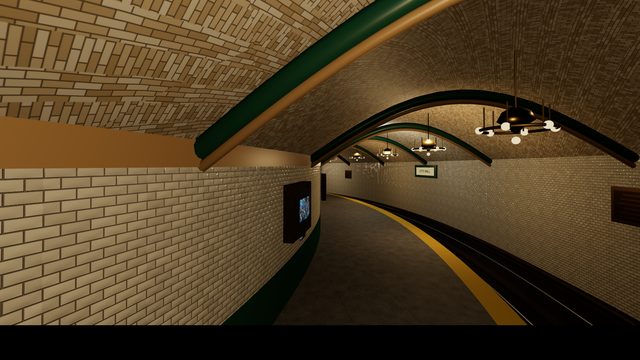
The first station of the first subway, opened in 1904 and closed to passengers at the end of 1945, still the loop every 6 train uses to turn round under City Hall Park. You stand on the curved platform under Guastavino tile vaults with chandeliers hung from their centres and leaded glass skylights letting in a little of the park above, while a train of silver cars comes slowly out of one tunnel mouth and round into the other. The New Yorkers hang on the curved platform wall, in the mezzanine up the stair and in the passage toward the park.
The City Hall station opened on October 27, 1904 with the first subway and its final day of service was December 31, 1945: the platform could not be lengthened for ten car trains and the Brooklyn Bridge station was a short walk away; in its last year it counted 255,000 entries. It has a single balloon loop track along a concave platform 240 feet long on a curve with a radius of 147.25 feet, which left two foot gaps between the train doors and the platform. The ceiling is twelve Guastavino vaults in the Romanesque Revival style, the main consulting architects were Heins and LaFarge, three of the vaults had leaded glass skylights opening to vault lights in City Hall Park, and twelve chandeliers with floral motifs and nickel finishes hung from the centres of the vaults. Three bronze plaques designed by Gutzon Borglum face the platform from the trackside wall. Passengers who stay on the 6 as it goes round the loop to head back uptown can still see the station; the city made it a landmark in 1979, it joined the National Register of Historic Places in 2004, and by the mid 2000s the Transit Museum was again giving tours to its members.
Source · City Hall station (IRT Lexington Avenue Line), Wikipedia ↗
The curved platform on a balloon loop, the twelve Guastavino tile vaults with their green and tan ribs, the chandeliers, the three leaded glass skylights, the tiled station name tablets and the three bronze plaques on the trackside wall, the mezzanine with its oak ticket booth under its own vault, the stair up toward City Hall Park and the iron gate at the top, a 6 train of silver cars with lit windows riding the loop, a tour group on the platform, and a rat on the track bed. Mood: a 6 train turning round under 1904. Everything is procedural geometry with painted surfaces; nothing is a scan or a photograph. The room is an interpretation, and it hangs the New Yorkers the census recorded at this place first.