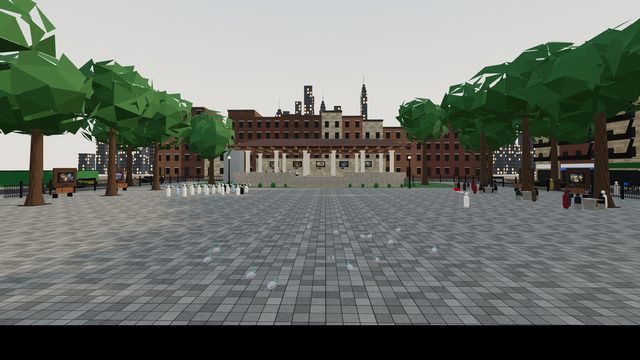
Columbus Park at seven in the morning, on the ground that was Mulberry Bend: two tai chi groups moving as one on the plaza, crowds of elders three deep round the xiangqi tables under the planes, music under the pavilion of 1897 at the north end, pigeons underfoot, delivery bikes on Mulberry Street and the tenements with their fire escapes catching the first sun. Across Baxter Street to the west, the cleared lot where the Tombs stood until 2024 and the towers of the Criminal Courts Building. The New Yorkers hang on the pavilion's back wall, on the park's iron fence facing in, on the handball wall and on the courts' fence, and a census wall covers the limestone comfort station of 1934.
Columbus Park, bounded by Baxter (formerly Orange), Worth (formerly Anthony), Bayard and Mulberry Streets, stands on Mulberry Bend, the curve of Mulberry Street at the heart of the Five Points, which Jacob Riis called the foul core of New York's slums in How the Other Half Lives; his 1888 photograph Bandits' Roost, 59 1/2 Mulberry Street was taken in the Bend, whose alleys included Bandit's Roost, Bottle Alley and Ragpickers Row. Calvert Vaux, co designer of Central Park, planned the park in the 1880s; the tenements were demolished in 1897 and Mulberry Bend Park opened in the summer of 1897 with bench lined curved walkways and an open grassy area. It has also been called Five Points Park and Paradise Park, and in 1911, after a redesign by Frederick Law Olmsted and Calvert Vaux, it was renamed Columbus Park. The open air pavilion at the north end was built in 1897 in the administration of Mayor William L. Strong, was closed for about thirty years, and was restored in 2007. In 1934 a limestone recreation center, now a public restroom, was built; work that began in August 1934 added trees and expanded the playground, and on Columbus Day the reopening drew an estimated 15,000 people while the Bronx Homing Pigeon Club released 442 homing pigeons, one for each year since 1492. A statue of Columbus by Emma Stebbins, sculptor of the Angel of the Waters at Bethesda Fountain, stood in the park from 1934 until 1971. In 1970 the Chinese American Arts Council launched the Chinatown Outdoor Summer Festival here, which by 1980 ran from traditional Chinese opera to folk dance and modern pop. Basketball courts came in the 1980s, and a ball field renovation announced in February 2004 with $1.1 million from the estate of Joseph Temeczko, completed by December 2005, gave 60 percent of the field to synthetic turf and 40 percent to asphalt for three basketball and three volleyball courts. The park covers 3.23 acres. As of 2013 the neighbourhood meets here to play mahjong, perform traditional Chinese music and practise tai chi in the early mornings, and the tables draw xiangqi players and onlookers. Mott Street below Canal, Mulberry, Bayard, Pell, Doyers and Worth Streets were settled by Chinese immigrants from the 1870s; Ah Ken is credited as the first Chinese person to settle permanently, in the 1850s; the Chinese population was about 200 by 1870 and 2,000 by 1882, when the Chinese Exclusion Act was passed; Chinatown today holds an estimated 90,000 to 100,000 people, the highest concentration of Chinese people in the Western Hemisphere. Across Baxter Street stood the Manhattan Detention Complex at 125 White Street, called the Tombs after the Egyptian Revival Halls of Justice of 1838 by John Haviland; the Art Deco Manhattan House of Detention of 1941 by Harvey Wiley Corbett and Charles B. Meyers became its south tower, reopened in 1983 after a 1974 closure ordered by Judge Morris E. Lasker, a north tower was completed in 1990, the complex was named the Bernard B. Kerik Complex in December 2001 and lost the name in 2006, and its demolition was completed in August 2024 for one of the four borough jails meant to replace Rikers Island, expected to be finished in 2032.
The raised open air pavilion of 1897 with its wooden roof beams and its new elevator, the paved plaza, the xiangqi tables with concrete stools and their standing crowds, tai chi with red fans, the 1934 limestone comfort station, the turf field with three basketball and three volleyball courts, the playground, the iron picket fence, London planes, the tenements of Mulberry Street with fire escapes and plain coloured shop boards, the Criminal Courts Building, and the hoarding round the site of the Tombs on Baxter Street. Mood: seven in the morning, everyone already here. Everything is procedural geometry with painted surfaces; nothing is a scan or a photograph. The room is an interpretation, and it hangs the New Yorkers the census recorded at this place first.