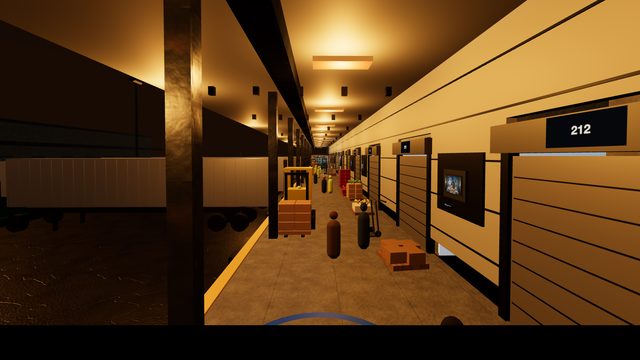
The Hunts Point Produce Market at three in the morning, the busiest hour of its day: a refrigerated warehouse a third of a mile long with numbered dock doors, trailers backed in with their reefers running, forklifts racing pallets along the dock under sodium light, buyers with hand trucks, a coffee cart, breath in the cold and the Bronx night over the yard. The New Yorkers hang on the dock wall between the doors, in the dispatcher's office, and on a pallet of framed works stacked on the dock as if they came in with the produce.
Hunts Point is a peninsula at the confluence of the Bronx River and the East River, bounded by the Bruckner Expressway to the west and north. The Hunts Point Food Distribution Center covers 329 acres of it and holds over 800 businesses employing over 25,000 workers. The produce market opened in 1967 in four buildings each a third of a mile long with 475,000 square feet of warehouse space; it sells approximately 2.7 billion pounds of produce a year and posted 1.5 billion dollars in revenue in 1998. The meat market followed in 1974, and the Fulton Fish Market moved here from downtown Manhattan in 2005, into a 450,000 square foot building that cost 85 million dollars, after 180 years by the South Street piers. The market's own site says it spans over a million square feet at 772 Edgewater Road with more than thirty produce merchants, in a trade with a history going back more than two hundred years. The market is served by rail through the Oak Point Yard and receives around 2,700 rail cars a year. In January 2021 over 1,400 workers at the market went on strike for a wage increase.
The long dock under its steel canopy, the numbered roll up doors, the door that rolls up as you reach it and the cold room behind it, the trailers backed to the bumpers with their reefer units, the tractors with their marker lights, the trailer backing in from the yard, six forklifts on the dock with pallets and amber beacons, the stacked cases and open bins of oranges, the buyers with hand trucks, the coffee cart and its steam, the dispatcher's office with its clock on New York time, the far warehouse row and the high mast lights over the yard. Mood: sodium light, cold air, forklifts. Everything is procedural geometry with painted surfaces; nothing is a scan or a photograph. The room is an interpretation, and it hangs the New Yorkers the census recorded at this place first.